In short: the right reward threshold for a loyalty card depends on two numbers you already know: how often your regulars come in and your gross margin. Aim for a reward that can be reached in three to six weeks and costs less than 5% of the margin earned during the cycle. For a café, that is often 10 visits; for a hair salon, more like 5 or 6. Calculate, test for three months, adjust.
Setting the reward threshold for your loyalty card means choosing between 6, 8 or 10 stamps and deciding what to give away. Set it too low and you hand margin to customers who would have come back anyway. Set it too high and the card ends up forgotten at the bottom of a wallet, bringing nobody back.
How many visits should a customer make before earning a reward?
The right number of visits is the one a regular reaches in three to six weeks. Divide the threshold by the weekly frequency of your best customers: someone who comes in three times a week fills 10 stamps in just over three weeks. Beyond two months, the reward feels too far away to change anyone's behaviour.
Perceived distance matters as much as actual distance. A study by Kivetz, Urminsky and Zheng on a coffee card, summarised by the Chicago Booth Review on the goal-gradient effect, shows that the time between two purchases shrinks by about 20% from the first stamp to the last. A reachable threshold therefore generates extra visits; one that is out of reach generates none.
The second lever: don't start from zero. At a car wash (as reported by Knowledge at Wharton), Nunes and Drèze compared a 10-space card with 2 spaces already stamped against an 8-space blank card. Same effort, but according to their paper on the endowed progress effect (Journal of Consumer Research), the task that was already under way was completed more often, and faster. Giving two stamps at sign-up is a free setting worth trying.
How do you calculate what a reward really costs your margin?
The real cost of a reward is its cost price, not its selling price. Compare it with the gross margin earned during the cycle: threshold × average basket × gross margin rate. If the reward costs less than 5% of that margin, the programme more than pays for itself through the visits it brings in.
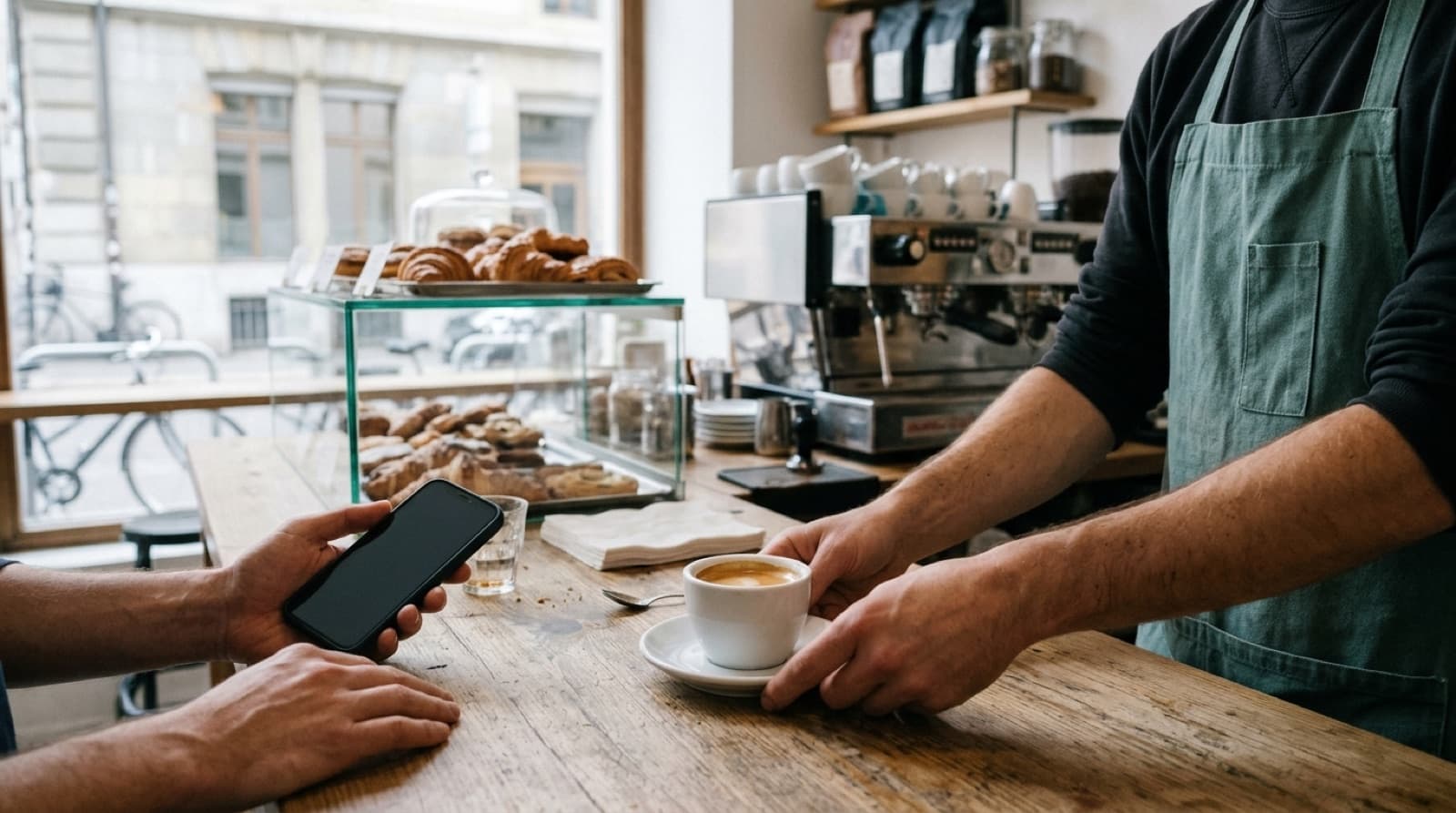
A worked example for a neighbourhood café: an espresso sold at CHF 4.50, an average basket of CHF 6, a 70% gross margin, and a free coffee after 10 visits. Margin for the cycle: 10 × 6 × 0.70 = CHF 42. The free coffee costs about CHF 0.80 in ingredients: 1.9% of the cycle's margin. At face value, it represents 7.5% of the cycle's revenue: that is the figure that scares people, and it is the wrong one. The terms are defined in our customer loyalty glossary.
This calculation is conservative: it ignores the value of a customer who stays. Frederick Reichheld's work at Bain, cited by the Harvard Business Review on the value of loyal customers, estimates that a 5% increase in retention raises profits by 25% to 95%. What it costs to bring a customer back compared with winning a new one is covered in our article on the cost of customer loyalty for local shops.
Calculate the reward threshold for your loyalty card
30 minFour calculations to do with your till receipts to set a reachable threshold that protects your margin.
Measure how often your regulars come in(10 min)
Using one month of receipts, identify your 20 most regular customers and count their visits per week. Take the median, not your best customer.
Set the threshold based on time(5 min)
Multiply that weekly frequency by 4: you get a threshold reachable in about a month. Round it to a simple number (5, 6, 8 or 10).
Calculate the margin for the cycle(5 min)
Threshold × average basket × gross margin rate. This is what the customer leaves you before collecting the reward.
Check the cost of the reward(10 min)
Divide the cost price of the reward by the margin for the cycle. Under 5%, go ahead. Above that, choose a cheaper reward rather than raising the threshold.
Product, discount or experience: which reward should you choose?
Choose the reward whose perceived value exceeds its cost price by the widest margin. A free house product (coffee, pastry, short treatment) costs little and is highly visible. A percentage discount costs pure margin. An experience (early access, workshop, priority service) mainly costs time and builds a relationship that a discount does not.
| Reward | Real cost to you | Perceived value | Good for |
|---|---|---|---|
| Free house product | Cost price, well below the listed price | Listed selling price | Café, bakery, restaurant |
| % discount on the next purchase | Pure margin, on an unknown basket | Average, quickly forgotten | Shops with variable baskets |
| Voucher in CHF | Cost price of the goods chosen | Good, clear | Shop, delicatessen |
| Service or experience | Working time, few materials | High, personal | Hairdresser, beauty salon, gym |
One rule holds everywhere: give away what you make, not what you buy in. A free home-made croissant costs you its ingredients; a bottle bought from a supplier costs you almost its full price.
What settings work for a café, a hair salon or a shop?
| Business | Frequency of a regular | Suggested threshold | Reward | Cost as a share of cycle margin |
|---|---|---|---|---|
| Neighbourhood café (CHF 6 basket, 70% margin) | 3 times a week | 10 visits, 2 given at sign-up | One coffee (cost CHF 0.80) | About 2% |
| Hair salon (CHF 60 cut, 60% margin) | Every 6 weeks | 5 cuts | Free treatment (CHF 6 product, 10 minutes) | About 3% excluding time |
| Shop (CHF 80 basket, 50% margin) | Once a month | 1 point per franc, reward at 300 points | CHF 15 voucher | About 5% |
These are example figures: redo them with your own receipts. The hair salon is the tricky case: with one visit every six weeks, 10 stamps means waiting more than a year. Five cuts, or about seven months, is the upper limit. For the shop, a spend-based threshold (CHF 300) is fairer than a visit-based one, because the basket varies too much. It takes a monthly customer about four months: for low-frequency businesses, the six-week benchmark no longer holds, and the reward has to make up for the wait. For restaurants, tiered and per-dish variants are covered in our 7 loyalty programme mechanics for restaurants.
When and how should you adjust your threshold?
Adjust your threshold after three months of data, not before. Look at two numbers: the share of cards that reach the reward and the average time it takes to get there. If almost nobody gets there, the threshold is too high. If everyone gets there within two weeks, you are giving rewards away too quickly.
Three benchmarks to help you decide. Fewer than one card in five completed in three months: lower the threshold or add welcome stamps. Reward reached in under two weeks by most customers: make it more generous rather than tightening the threshold, because taking away a benefit annoys people. Frequency not changing: the problem lies with the reward, not the threshold. Change only one variable at a time.
With a paper card, these numbers don't exist: nobody knows how many cards are sitting in drawers (see our comparison of paper and digital loyalty cards). A digital card counts them for you and makes progress visible to the customer. Apple also announced at WWDC 2026 that, with iOS 27, Featured Actions are being extended to all Wallet pass types: merchants will be able to place actions such as "view my rewards" below the card. To set it up, follow our digital loyalty card guide.
Frequently asked questions about reward thresholds
Should a café choose 6, 8 or 10 stamps?+
If your regulars come in several times a week, 10 stamps take three to four weeks to collect. If they come once a week, go down to 6 or 8. What matters is the time it takes, not the number.
Is it better to offer a product or a discount?+
A house product is almost always more profitable: the customer sees its selling price, you pay its cost price. A percentage discount takes away pure margin; keep it for very variable baskets.
Is giving stamps at sign-up worth it?+
Yes, if the card becomes 10 spaces with 2 already filled: the effort stays the same as 8 empty spaces. According to Nunes and Drèze, progress that has already started increases the chances of completing the card and shortens the time it takes.
What share of margin should go to rewards?+
A working benchmark: less than 5% of the gross margin for the cycle, based on the cost price of the reward. A free coffee after 10 visits represents about 2%. Above that, change the reward before touching the threshold.
Can you change the threshold of a programme that is already running?+
Yes, after three months of data. Announce it in advance and let cards in progress finish under the old rule. Your regulars will see a higher threshold without a more generous reward as a step backwards.
What are the key takeaways?
A reward threshold takes half an hour to work out with your till receipts. Set it so your regulars reach it in three to six weeks, give away what you make rather than a discount, and check that the reward costs less than 5% of the cycle's margin. Then let it run for three months before adjusting. With Emuna, your card lives in your customers' Wallet, with no app to install, and you track completions and timings without a spreadsheet: bring your customers back without spending your evenings on it.