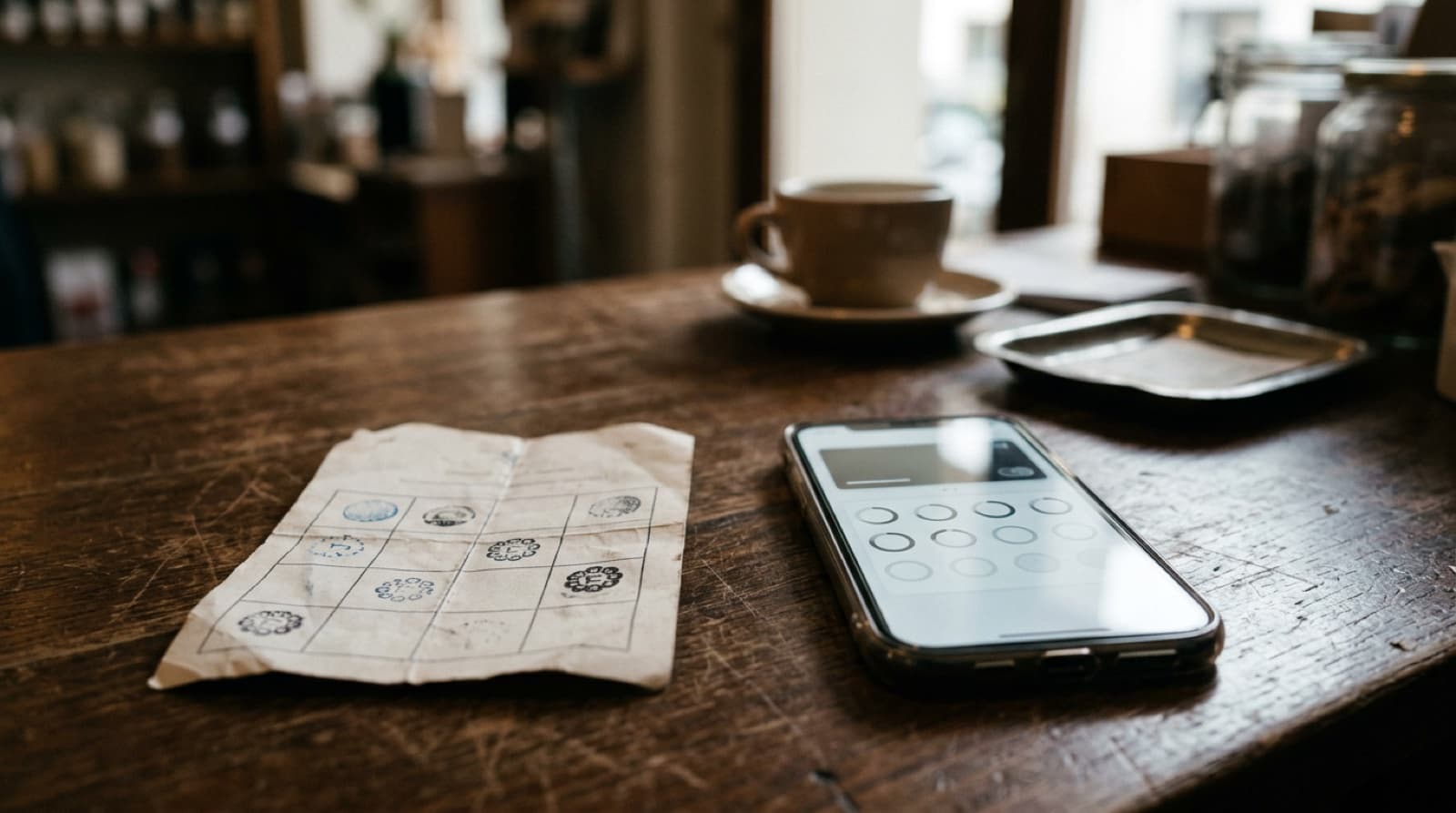
The paper stamp card has kept generations of customers coming back, and it has disarming simplicity on its side. The digital card promises to do everything better, but it requires a subscription and a small change of habits. Rather than a sales pitch, here is a point-by-point comparison, including the cases where paper still holds up.
How do paper and digital compare at a glance?
| Criterion | Paper card | Digital card (wallet) |
|---|---|---|
| Initial cost | Printing (≈ CHF 100–300 per batch) | CHF 0 (created online) |
| Recurring cost | Reprints | Subscription (≈ CHF 20/month) |
| Loss rate | Very high (drawer, washing machine...) | Almost zero (it lives in the phone) |
| Customer data | None | First name, email, visit history |
| Customer follow-up | Impossible | Notifications and targeted campaigns |
| Fraud (copied stamps) | Easy | Secure, traceable scan |
| Programme updates | Full reprint | Instant |
| FADP compliance | Not applicable (no data) | Depends on the solution |
| Customer adoption | Immediate | QR code, ≈ 30 seconds |
Where does digital clearly win?
Return rate. This is what really matters: a card that is no longer in the customer's pocket will never bring them back. A wallet card is, by definition, always there, and it can remind the customer of your shop at the right moment.
Customer knowledge. With paper, your most loyal customers remain anonymous. With digital, every activation builds your customer file: who comes, how often, who has dropped off. That is the difference between putting up with your footfall and actually steering it.
Fraud prevention. An ink stamp can be copied at any office supply shop. A time-stamped, traceable scan cannot.
Where does paper still have a case?
Let's be honest: paper retains three real advantages.
No subscription. If your customer base is very small or your business is seasonal, a monthly subscription may not be worth it.
No reliance on smartphones. Older or less tech-savvy customers may prefer a piece of card. (In practice, the friction is lower than people fear: adding a card to a wallet has become an everyday gesture.)
No data, no obligations. No data collected, no obligations under the revised Federal Act on Data Protection (FADP). That is genuine simplicity, at the price of knowing nothing about your customers.
What do the numbers actually say?
Take a Geneva café serving 80 customers a day. A batch of 1,000 printed cards costs around CHF 150 and is gone within a few months, most of them never to return. The digital solution costs around CHF 240 a year. So the question is not the raw cost, which is almost the same, but the return: how many customers come back thanks to the programme? With even a slightly higher retention rate, driven by follow-up messages and the fact that the card can no longer be lost, digital pays for itself with a handful of extra visits a month. One more regular customer often covers the subscription.
Frequently asked questions
Can I run paper and digital side by side during the transition?+
Yes, and it is actually recommended. Offer the digital card by default, keep a few paper cards for customers who prefer them, and carry over existing paper stamps when customers activate the digital card so that nobody loses out.
Will my older customers follow?+
More than you might think: scanning a QR code has become second nature. For the rest, keeping paper alongside digital settles the question without any frustration.
Is digital really profitable for a small shop?+
As a rough guide: a subscription of around twenty francs a month is covered as soon as it generates one or two extra visits a month. With targeted follow-ups and a card that cannot be lost, that threshold is reached very quickly.
So which one should you choose?
For the vast majority of local businesses (restaurants, hairdressers, beauty salons, retail), digital wins hands down as soon as customer loyalty matters: the card no longer gets lost, customers become identifiable, and follow-ups bring them back. Paper remains a reasonable choice for very small businesses with no need for data. To dig into the practical set-up, our complete guide to the digital loyalty card walks through every step.