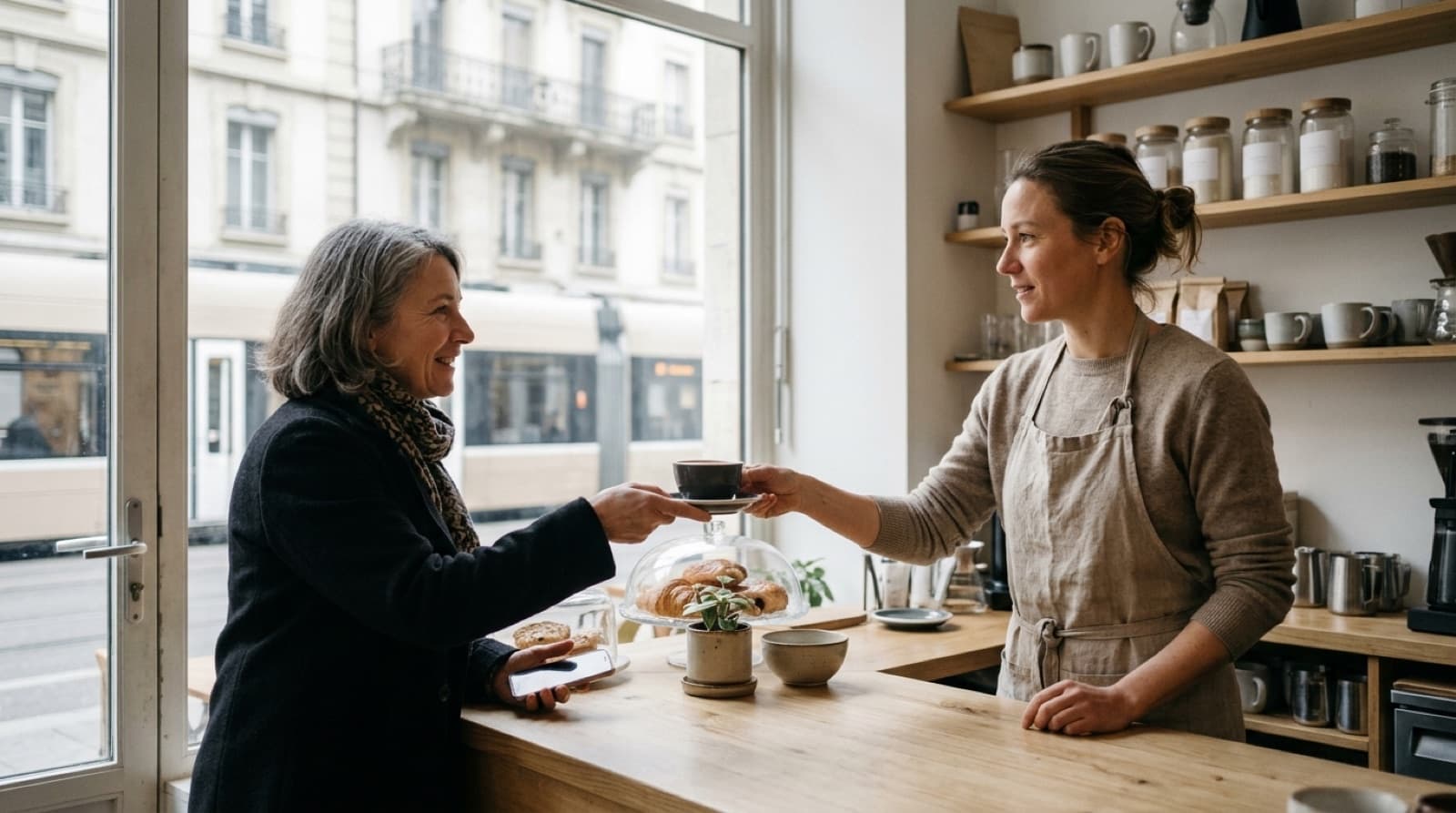
In short: according to the studies cited by the Harvard Business Review, acquiring a new customer costs 5 to 25 times more than keeping an existing one. In our neighbourhood café example, it takes around CHF 68 to win one new regular, while an existing customer who comes in twice more a month brings CHF 109 of extra margin a year. Run the numbers with your own till data before your next spend.
Building customer loyalty is often the job a local shop keeps putting off. There is always something more urgent: the morning delivery, the staff rota, the shop window. And when takings drop, the first instinct is to go looking for new people: flyers, a welcome offer, a sponsored post.
The instinct is understandable, but it is expensive. A passer-by drawn in by a promotion will not necessarily come back. A regular is already convinced: they know the way, they know what they order, and they recommend you to their colleagues. In Geneva, where the Observatoire du commerce genevois counts around 7,000 shops across 18 categories, your customer always has an alternative two streets away. Keeping them is your best investment.
This article sets out the actual calculation, using illustrative figures you will replace with your own: what a new customer costs, what a regular brings in, why a few points of retention change your margin, the three levers within reach of a micro-business and the budget not to exceed.
How much does a new customer really cost a neighbourhood shop?
A new customer costs everything you spend to bring them in (printing, distribution, welcome offer, advertising), divided by the number of people who actually come back afterwards. For a neighbourhood shop, that cost runs to tens of francs per regular won, far more than the price of a single visit.
The benchmark figure comes from an article by Amy Gallo in the Harvard Business Review: acquiring a new customer costs five to 25 times more than retaining one, depending on the study and the industry. The range is wide because it depends on the channel. A word-of-mouth recommendation costs almost nothing; a paid campaign can cost more than the first basket.
Take a café in Plainpalais. The amounts below are illustrative assumptions, not market averages. The owner has 1,000 "free coffee" flyers printed and distributed to the neighbouring buildings for CHF 300. Twenty people come in for their coffee, which costs him about CHF 1.95 in ingredients each, or CHF 39 in total. Three months later, five of them have become regulars.
| Item (illustrative example) | Amount |
|---|---|
| Printing and distributing 1,000 flyers | CHF 300 |
| 20 free coffees (cost of goods) | CHF 39 |
| Total campaign cost | CHF 339 |
| Visitors brought in by the flyer | 20 |
| Visitors who became regulars | 5 |
| Cost per new regular | around CHF 68 |
The classic trap: dividing CHF 339 by 20 visitors and concluding it cost CHF 17 per customer. That is wrong. A visitor who never comes back is not a customer, they are a cost. The only honest denominator is the people who return.
What is a customer who comes in twice more a month worth?
Two more visits a month means twenty-four extra visits a year, with no acquisition cost at all. With a CHF 6.50 basket and a 70% gross margin, a single, slightly more loyal regular brings in around CHF 109 of extra margin every year. Now multiply that by your fifty best customers.
Back to our café, still with assumptions to adapt. Average basket: a coffee and a croissant, CHF 6.50. Gross margin after cost of goods: 70%, or CHF 4.55 per visit. A customer comes in four times a month. If she moves up to six, here is what changes.
| Frequency (example) | Visits per year | Annual revenue | Annual gross margin |
|---|---|---|---|
| 4 visits per month | 48 | CHF 312 | CHF 218.40 |
| 6 visits per month | 72 | CHF 468 | CHF 327.60 |
| Difference | +24 | +CHF 156 | +CHF 109.20 |
Compare the two: it took around CHF 68 to bring in one new regular, who will only deliver their margin month by month if they stay. The existing customer, meanwhile, brings in CHF 109 more a year as soon as you give her a reason to come through the door twice more. The same logic applies to a barber (a cut every four weeks instead of six) or a bakery (the Saturday loaf on top of the weekday one).
And regulars bring what the table does not show: they recommend you, they forgive a busy day, they try the new item you are testing. They are the customer base that carries your shop through the quiet months.
Why does 5% more retention change your margin?
Because retention compounds. Every regular you keep goes on bringing in revenue the following year, with no new spending to replace them. The work of Frederick Reichheld at Bain & Company, cited by the Harvard Business Review, links a 5% increase in retention to a 25% to 95% increase in profits.
Reichheld's figure, as reported by the HBR, comes from studies of large companies, not Geneva cafés. Do not treat it as a promise for your till. Keep the mechanism in mind instead, because it applies to any shop: your fixed costs (rent, wages, subscriptions) do not change when a regular stays. Almost every visit you retain goes straight to your margin.
Do the maths on your own customer base. Our café has 200 regulars in January. Without any particular effort, it loses 30% of them over the year (a house move, a new job, a competitor opening nearby). With a simple programme, it loses only 25%. That is five points of retention.
| Regulars remaining (example) | 30% lost per year | 25% lost per year | Difference |
|---|---|---|---|
| After 1 year | 140 | 150 | +10 |
| After 2 years | 98 | 113 | +15 |
| After 3 years | 69 | 84 | +15 |
Ten more regulars from the first year, at six visits a month and CHF 4.55 of margin per visit, add up to around CHF 3,270 of annual gross margin. To get the same result through acquisition, you would have to run new campaigns every year, at the cost you saw above. Retention works for you; acquisition has to be bought again and again.
Which loyalty levers can a micro-business realistically use?
Three levers are enough to build customer loyalty in a local shop: recognise your regulars, reward regular visits with a simple mechanism, and win back those who are drifting away. None of them needs a marketing team. They need consistency and a tool that does not eat into your evenings.
1. Recognise: the free lever
The first name, the usual order, the question about their holiday. This is what a neighbourhood shop does better than any chain, and it costs nothing. The limit: it depends on the memory of whoever is behind the counter. When that person is on leave, the connection breaks. At the very least, keep a note of your most regular customers, and train stand-in staff to recognise them.
2. Reward: a rule the customer understands in three seconds
The tenth coffee free, a half-price haircut after five visits, a bonus for the second visit of the week. The mechanism matters less than how clear it is. The 7 loyalty mechanics for restaurants go through the options, from the classic stamp card to regular status, along with their pitfalls. If you are still unsure about the format, the paper vs digital loyalty card comparison sets out the costs and limits of each.
3. Win back: catch the regular who is drifting away
A customer who used to come every week and has not been seen for a month is on the way out. Winning them back costs far less than replacing them. This lever means knowing who your customers are and when they last came in, which a paper card will never tell you. A digital loyalty card in Apple Wallet or Google Wallet shows you exactly that and lets you send a targeted offer.
These three levers are yours, under your own name. They combine with the canton's collective programmes: for example, Raiffeisen and Genève Avenue offer 5% cashback in more than 100 local shops to MemberPlus members. A collective programme draws customers to the neighbourhood; your own programme brings them back to you.
A word on Google reviews, which influence whether new customers come in. According to the BrightLocal 2026 Local Consumer Review Survey, 97% of consumers read reviews of local businesses and 74% look for reviews less than three months old. Your regulars are your best reviewers. But be careful: Google's review policies prohibit offering a discount or a product in exchange for a review, and asking only satisfied customers. Ask everyone, with nothing in return, and keep your rewards for loyalty.
How can you calculate your own ratio in 15 minutes?
You need four figures: the cost of your last acquisition campaign, the number of customers it actually turned into regulars, your average basket and your gross margin. With them, you can compare in a quarter of an hour the cost of a new regular and the value of one extra visit from an existing customer.
Calculate the acquisition vs retention ratio for your shop
15 minFour figures from your till are enough to tell whether your next franc should go to acquisition or to retention.
Add up the cost of your last campaign(3 min)
Go back to your last effort to bring people in (flyers, sponsored post, welcome offer). Add up everything: printing, distribution, advertising, and the cost of goods for anything you gave away.
Count the customers you really won(4 min)
Estimate how many of the people who came because of that campaign returned at least three times within three months. Divide the total cost by that number: this is your cost per new regular.
Work out the margin on one visit(3 min)
Take your average basket from last month (revenue divided by the number of receipts). Multiply it by your gross margin rate: this is what one visit brings in.
Put a value on two more visits(2 min)
Multiply the margin on one visit by 24 (two more visits a month for a year). This is what a slightly more loyal regular is worth.
Compare and decide(3 min)
Put the cost per new regular next to the value of two more visits. If the second is clearly higher than the first, your next franc should go to retention.
No precise figure for the number of customers you won? That in itself tells you something: you are spending money to bring people in without knowing what it brings back. Start measuring, even roughly, before your next campaign.
How much should you invest in loyalty without losing money?
Your programme must generate more visits than it costs in rewards and tools. The rule of thumb: divide the total annual cost by the margin on one visit. The result is the number of extra visits you need over the year to break even. Beyond that, every visit is profit.
There are two costs to work out. First, the rewards. A tenth coffee free is the equivalent of a 10% discount reserved for returning customers, and in our example it costs only CHF 1.95 in ingredients. Second, the tool. A paper card only costs the printing, but gives you no data. A digital card means a subscription, in the region of CHF 20 a month for a tool like Emuna, or about CHF 240 a year.
Break-even calculation, still with CHF 4.55 of margin per visit: CHF 240 divided by 4.55 gives around 53 extra visits a year. Across 150 cardholders, that is one extra visit every three years per customer. The bar is low. The real risk is not the cost of the tool, it is a reward that is too generous: a free coffee from the third visit rewards people who would have come anyway.
Which option suits your shop?
| Your situation | Best-suited option | Why |
|---|---|---|
| Fewer than 30 regular customers, no budget | Recognition + paper stamp card | Almost no cost, enough to test a reward |
| More than 50 regulars, want to know who is leaving | Digital card in the phone Wallet | Visit data, targeted win-back, no app to download |
| Shopping street with an active association | Collective programme + your own card | The collective draws people to the area, your card brings them back to you |
As soon as you collect customer data (first name, phone number, visit history), the revised Federal Act on Data Protection (FADP) applies. Since it came into force on 1 September 2023, any collection of personal data must be preceded by informing the person concerned. Tell your customers clearly what you record and why, at the moment they join the programme.
Frequently asked questions
Is it true that a new customer costs 5 times more than a loyal one?+
The range cited by the Harvard Business Review is 5 to 25 times, depending on the study and the industry. The exact figure depends on your channels: word of mouth costs almost nothing, a paid campaign much more. The only ratio that matters is yours, calculated with your own till figures.
How can I tell whether my customers are loyal?+
Look at the share of your revenue that comes from familiar faces and how often they visit. Without a tool, you estimate it by eye. With a digital loyalty card, you can see who comes back, how often, and who has not been in for a month.
Should I stop looking for new customers?+
No. A shop loses regulars every year, through house moves or job changes, and needs to replace them. What matters is the order of priorities: first keep the customers you have, then acquire new ones to make up for those who leave, measuring how many newcomers actually stay.
What reward can I offer without losing margin?+
A reward calculated on the cost of goods, not the selling price, and triggered late enough to reward genuine regularity. A tenth coffee free is equivalent to a 10% discount reserved for regulars. A reward from the third visit mostly pays customers who would have come anyway.
Is a loyalty programme worth it for a small shop?+
Yes, as soon as it generates more visits than it costs. Divide the annual cost of the tool and rewards by the margin on one visit: this gives you the number of extra visits you need. For a subscription of around CHF 240 a year, that is about fifty visits over the year.
Key takeaways
Three things to remember. A new customer costs far more than the price of their first coffee: count it per regular won, not per visitor. An existing customer who comes in twice more a month often brings in more than an entire campaign. And a few points of retention compound year after year, on fixed costs that do not change.
Your action for this week: spend fifteen minutes with your till figures and work out your own ratio. If retention comes out ahead, start with a simple reward rule and a way of knowing who comes back. The digital loyalty card guide shows you how to get started without asking your customers to install an app. Bringing your customers back without giving up your evenings: that is where your neighbourhood shop has the edge over every chain.