In short: a shared loyalty scheme such as Localistes (run by Genève Avenue) puts you in front of customers who do not know you yet. It costs you an annual subscription plus 5% cashback on every scanned receipt, and the customer data stays with the network. A card in your own name brings your regulars back and keeps the relationship with you. You can run both: choose based on how often customers visit and on the discount rule.
A network offers you cashback and city-wide campaigns. If you join a loyalty scheme for shops in Geneva, do you still need your own card? It all depends on the job you need done: attracting a passing customer, or bringing back one who has already visited. This comparison is based on the terms published by the schemes themselves. For the general principle, see the cost of retention compared with acquisition.
How do Geneva’s shared loyalty schemes work?
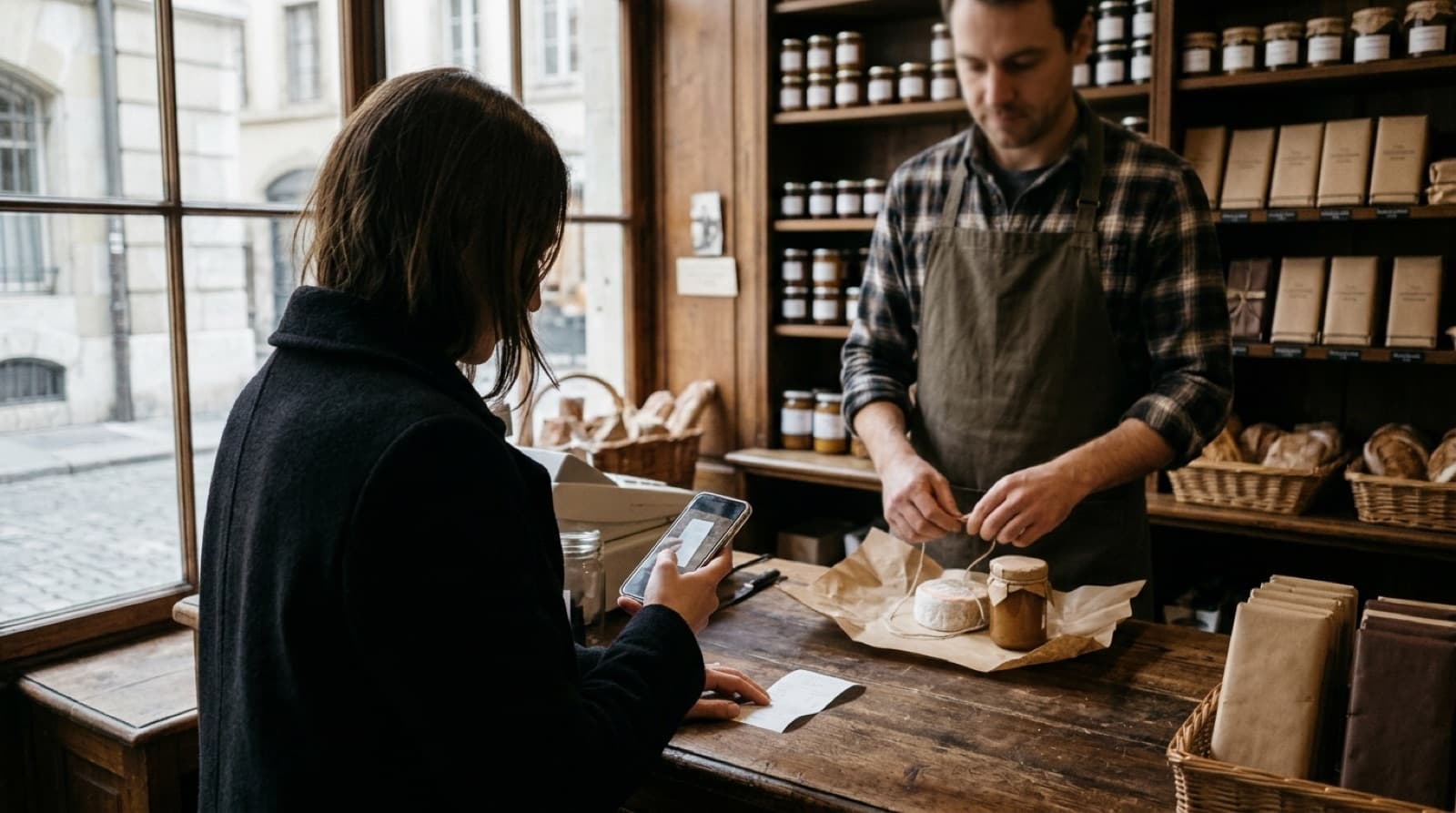
The customer pays full price, scans the receipt with their phone and receives 5% of the amount as cashback on a shared digital card. They can then spend that credit at any member shop. The cashback is charged to the shop where the original purchase was made, through a monthly statement.
The main network in Geneva is Localistes, operated by Genève Avenue. Its overview page sets out the process: the receipt is scanned on geneveavenue.ch, validated, then credited in CHF to the Localistes card. Cashback is capped at CHF 50 per receipt, and the customer has three months to spend it.
The network also comes in other versions. The Raiffeisen x Genève Avenue card gives 5% cashback in more than 100 local shops, but it is reserved for Raiffeisen members with MemberPlus status. Genève Avenue also offers a “Localistes abo+” version. These variants widen the pool of people scanning their receipts.
What does a network give you?
A network brings you customers from elsewhere. Cashback earned at another member can only be spent within the network, which encourages customers to try new places. You also benefit from joint campaigns. Your own card, by contrast, only speaks to people who already know you.
Joint campaigns are the most visible advantage. The 2025 Chasse aux Tickets d’Or, a golden-ticket hunt organised by Genève Avenue with unireso from 29 October to 12 November 2025, brought together 350 partner shops with the support of the canton. No neighbourhood shop could run an operation on that scale alone. The general terms for shops state that the subscription gives access to these marketing activities at no extra charge, and taking part is optional.
For context, the Observatoire du commerce genevois counts around 7,000 shops across 18 categories. With 350 participants, the campaign therefore reached roughly one shop in twenty. Being part of it still sets you apart on your street.
What do you actually pay?
There are three items. First, an annual subscription to Genève Avenue, with the amount agreed with each shop: a minimum 12-month commitment, billed per calendar year, with notice to be given by 30 September. Second, the cashback: the Localistes participation terms commit you to paying 5% on scanned receipts within 10 days of the monthly statement. Third, nothing on redemption: there is currently no commission when a customer pays you with their cashback.
In practice, a CHF 40 receipt costs you CHF 2, whether the customer is new or has been loyal for ten years. That is the point to keep in mind: the network also rewards purchases you would have made without it.
What does a card in your own name give you?
A card in your own name rewards customers for coming back to you, not to the shop next door. You set the reward, the threshold and the pace. Above all, you keep the relationship: you know who comes back and how often, and you can contact your customers with their consent. In a network, that data belongs to the network.
The data point is spelled out in black and white. Under Article 4.1 of the Genève Avenue general terms for shops, customer data generated by the platform is the exclusive property of Genève Avenue, and the shop may not use it for its own marketing. The network brings you a customer, but it does not hand that customer over to you.
With your own card, the list of your regulars is yours, within the framework of the revised Federal Act on Data Protection (FADP) as applied to loyalty data. You can win back a customer who has stopped coming or fill a quiet weekday. And you control the cost: see how to set the reward threshold without losing margin.
| Criterion | Shared network (Localistes) | Card in your own name |
|---|---|---|
| Main goal | Attract customers from other shops | Bring your own customers back |
| Cost | Annual subscription + 5% per scanned receipt | Subscription or fixed tool cost, reward set by you |
| Commitment | 12 months minimum, notice by 30 September | Depends on the provider |
| Where the customer spends the reward | At any network member | At your shop only |
| Customer data | Exclusive to the network | Yours, within the FADP |
| Collective visibility | City campaigns, member directory | None, you build it yourself |
| Settings | 5% by default, more if you wish | Threshold, reward and pace are up to you |
Can you combine a shared scheme with your own loyalty card?
Yes. Nothing in the terms published by Genève Avenue prevents a shop from having its own loyalty card. The network handles acquisition, your card handles return visits. One rule does need attention, though: no cashback if a discount has already been granted on the goods.
This restriction appears in Article 3 of the Localistes participation terms: customers cannot claim cashback if they have already been given a discount, and the calculation is based on the receipt total. If your card pays out as a discount on the receipt (10% on the 10th visit, for example), that receipt is excluded from cashback. The customer chooses, and your till needs to know which one applies.
In practice: reward with a free product rather than a percentage off the receipt (to be confirmed with Genève Avenue), explain the rule to your team, and read the figures separately. Cashback measures what the network brings in; your card measures who comes back.
Which should you choose for your type of shop?
Visit frequency is the deciding factor. A shop that customers return to every week benefits first from its own card, because cashback would reward purchases you already have. An occasional-purchase boutique in a busy passing area gets more from the network. In between, combining both makes sense if you measure the two channels.
| Your shop | Typical frequency | Priority | Why |
|---|---|---|---|
| Bakery, café, newsagent | Several times a week | Own card | Your customers already come back; 5% on every croissant weighs on a thin margin |
| Hairdresser, barber, beauty salon | Every 4 to 8 weeks | Own card, network optional | The relationship and a timely reminder matter more than footfall |
| Restaurant, bar | Variable | Both | The network fills tables with new customers, the card brings the good ones back |
| Gift, fashion or homeware shop | A few times a year | Network first | Customers come for a one-off purchase; discovery matters more than frequency |
| Shop off the main streets | Low footfall | Network, then card | Collective visibility makes up for the location, the card then keeps customers |
For borderline cases, ask customers at the till for two weeks how they found you. If almost all are regulars or came by word of mouth, your challenge is return visits, not discovery.
What are the key takeaways?
The network sells visibility in exchange for a subscription and 5% of every scanned receipt, and it keeps the data. Your own card has a cost you set and leaves the relationship with you. A shop visited every week: card first. A boutique for one-off purchases: the network opens doors. If you run both, settle the discount question from the outset.
With Emuna, your loyalty card carries your name and is added to Apple Wallet or Google Wallet, with no app to download. Our guide to digital loyalty cards explains the set-up, and our article on Apple Wallet and iOS 27 shows what changes for customers this autumn.
How much does Localistes cost a Geneva shop?+
An annual subscription to Genève Avenue, with the amount agreed with each shop, for a minimum of 12 months. Plus 5% cashback on every scanned receipt, capped at CHF 50 per receipt. There is currently no commission on redeeming cashback.
Do I get the data of Localistes customers?+
No. Under the Genève Avenue general terms, customer data generated by the platform belongs exclusively to Genève Avenue and cannot be used for your own marketing. To build your own customer list, you need your own programme.
Can a customer combine my loyalty card with Localistes cashback?+
Yes, except on a purchase that has already been discounted: in that case the customer cannot claim cashback. A free-product reward often avoids the conflict, to be confirmed with Genève Avenue.
How do I leave the Localistes programme?+
The Genève Avenue subscription runs for at least 12 months and is billed per calendar year. Notice must be given by 30 September each year.
Can I offer more than 5% cashback?+
Yes. The Localistes terms let you offer more than 5% or raise the cap that applies to receipts over CHF 1,000. It is a one-off lever for an opening or a quiet period.