In short: an in-store prize draw is allowed in Switzerland without a licence if it meets four conditions of the Federal Act on Gambling (Gambling Act): it serves to sell, it runs for a short time, it does not encourage excessive gambling, and the only "stake" is a purchase at the normal price. Miss one criterion and your draw becomes an illegal lottery. The safest option: a free draw, no purchase necessary, with modest prizes.
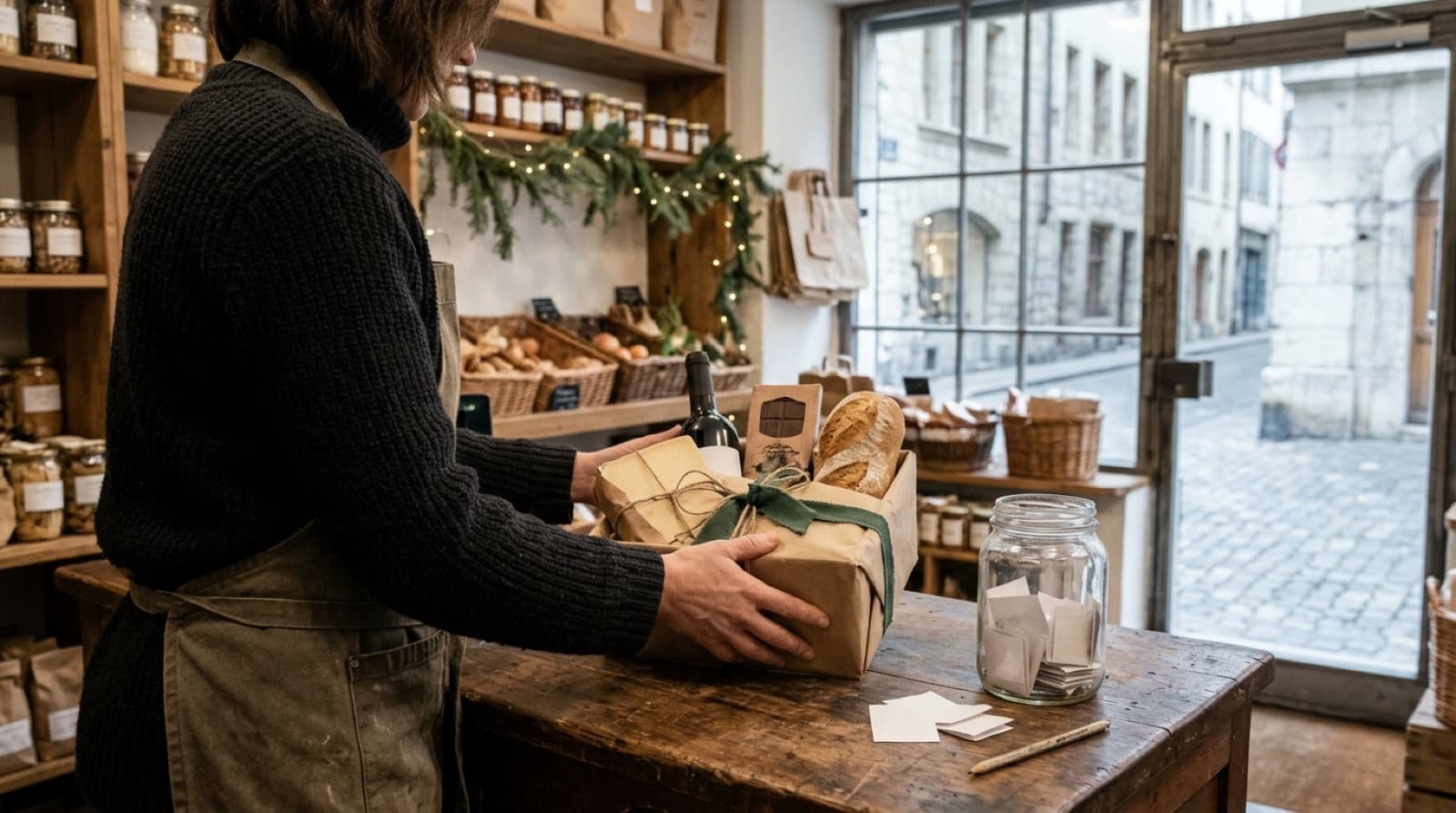
December is coming, and the same idea returns every year: an entry box by the till, a gift hamper to win, a draw on the 24th. Simple, friendly and effective at bringing customers back during the December Sunday openings. But an in-store competition in Switzerland falls under a strict law. Nobody checks your draw in advance, and that is precisely the trap: you alone are responsible for having read the rules correctly. Here they are, and how to tick them off in ten minutes.
Is an in-store prize draw a lottery?
Yes, as soon as it requires a stake. The law defines a game of chance by a stake (money or a purchase) and the prospect of a prize. A draw open to many customers is therefore a lottery. It can only run without a licence if it falls under the exception for sales promotion games.
The definition in Art. 3 of the Gambling Act covers games that, in return for a stake of money or the conclusion of a legal transaction, offer the prospect of a prize. Buying a coffee to receive an entry slip is concluding a legal transaction. Lotteries are games of chance open to an unlimited number of people and decided by a draw. Your Christmas entry box ticks both boxes.
Conversely, a game with no stake at all falls outside the law. According to the Federal Office of Justice FAQ, free games are excluded from the scope of the law, even if they offer a chance to win. That is why "free entry, no purchase necessary" remains the most worry-free formula.
Which conditions let a promotional game run without a licence?
Four cumulative conditions, set out in Art. 1 para. 2 let. d of the Gambling Act: the game promotes sales, it is offered for a short period, it poses no risk of excessive gambling, and entry is possible only by purchasing goods or services whose price does not exceed market prices.
The text of Art. 1 of the Gambling Act excludes these games from the scope of the law. The Gespa page on sales promotion games, the intercantonal supervisory authority, draws the conclusion: they can be organised without a licence. The only permitted stake is a purchase at market price.
| Condition | What it means in a shop | Example that works | Example that does not |
|---|---|---|---|
| Promotional purpose | The game serves to sell or build loyalty, not to make money in itself | One entry slip per purchase in December | Draw tickets sold at CHF 5 each |
| Short duration | A time-limited operation with an end date | From 1 to 24 December | A monthly draw with no end |
| No excessive gambling | Nothing that pushes people to buy more to increase their chances | One slip per visit | One slip per CHF 10 spent, high-value prize |
| Purchase at market price | The price does not rise because of the game | The croissant at its usual price | A "competition menu" priced above the regular menu |
The examples in the "does not" column are our practical reading of the criteria, not an official list. They flag situations where doubt becomes serious.
Free entry and short duration: what does Gespa say?
Gespa confirms that a game meeting all the criteria needs no licence, and that no authority supervises how it runs. A game that does not meet them all may be illegal, and Gespa can take action against the organiser. The law does not put a figure on "short duration".
In practice, Gespa does not check your game before or during the operation. The absence of checks is not an approval: it is up to you to be certain you tick all four boxes. Neither the law nor the Gespa page gives a number of days. A Christmas operation limited to a few weeks fits the spirit of the text; a permanent draw, much less so.
On free entry, the Federal Office of Justice specifies that, for a shop, offering free participation is not mandatory but remains possible. The obligation to offer a free route as advantageous as the paid one applies to media companies, with their SMS or phone competitions. For your shop, adding a free route is still the best insurance.
Which pitfalls make an in-store competition illegal?
The common mistakes: selling tickets, raising a price to fund the prizes, repeating the draw indefinitely, or offering a prize so big that it drives people to buy more. Each one breaks one of the four criteria and turns the game into a lottery that requires a licence.
The paid ticket. The Federal Office of Justice is clear: it is forbidden to run a promotional game to generate revenue from the game itself. Selling tombola tickets at the counter means organising a small lottery. In Geneva, the cantonal implementing regulation assigns these games to the trade police (PCTN). A recreational tombola there is capped at CHF 10,000 in tickets, with prizes in kind and a draw held at a social gathering. For an authorised small lottery, the net proceeds go entirely to a public-interest purpose: it is not a sales tool for a business.
The price that goes up. A "Christmas menu with entry to the draw" sold at a higher price than usual no longer meets the market-price condition. Keep your usual prices and promotions, displayed in CHF including VAT.
The draw that never ends. A monthly draw, all year round, moves away from the short-duration requirement. Choose a dated operation with an announced start, end and draw date.
The prize that is too good. A high-value prize combined with "one slip per amount spent" encourages people to buy in order to play. It also has a tax consequence: according to the Swiss Federal Tax Administration, the tax threshold is indexed every year; a CHF 1,100 win is not taxable, but above the threshold the whole win is. Gift vouchers count as winnings in kind. A gift hamper or a CHF 100 voucher avoids the issue.
The entry slip that hoovers up data. Name, phone number, email on the slip: that is a collection of personal data. Say what it is used for and ask for separate consent for the newsletter. Our guide to loyalty data and the revised Federal Act on Data Protection (FADP) sets out the rules.
Loyalty reward or prize draw: which should you choose?
A draw creates a spike of attention over a few weeks, with a single winner and many losers. A loyalty reward is not a game: every customer knows what they get and when. It falls outside the Gambling Act, since there is no element of chance, and it brings back all your regulars, not just the winner.
| Criterion | Christmas prize draw | Loyalty reward |
|---|---|---|
| Legal framework | Gambling Act exception, four conditions to meet | Not gambling: no element of chance |
| Who wins | One or a few customers | Every customer who reaches the threshold |
| Duration | Short by definition | All year round |
| Expected effect | Spike in visits during the operation | Repeat visits, steady basket |
| Cost | Value of the prizes, known in advance | Cost of rewards, adjustable |
The two work well together. A December draw attracts customers, a loyalty card keeps them afterwards. To set the threshold without eating into your margin, read our method for setting the reward threshold. If you run a restaurant, the 7 loyalty mechanics for restaurants offer other options without chance, and the Tuesday-night flash promotion fills a quiet evening without any draw.
What should you check before launching your competition?
Seven points to tick before setting up the entry box. If even one remains unclear, simplify the game rather than gamble on an interpretation.
Launch an in-store competition that complies with the Gambling Act
30 minThe steps to keep a promotional prize draw within the Gambling Act exception.
Set the dates(3 min)
Announce a start date, an end date and the draw date. A few weeks are enough for a Christmas operation.
Offer a free route(3 min)
Let people enter without buying, for example with a slip handed out on request at the counter. This is the safest formula.
Keep your usual prices(3 min)
Do not create any more expensive product "with entry". Check that your displayed prices have not changed.
Limit the chances per customer(3 min)
One slip per visit rather than one slip per amount spent, so as not to push people to buy in order to play.
Choose modest prizes(5 min)
A gift hamper, a voucher or a free service. Stay well below the threshold set by the Federal Tax Administration for withholding tax.
Write short rules(10 min)
Organiser, dates, entry conditions, prizes, draw method and date, how winners are informed. Display them next to the entry box.
Frame the data you collect(3 min)
Ask only for what you need to contact the winner, state the purpose and destroy the slips after the operation.
What comes after the draw?
A well-framed draw brings customers in during December. The real work starts in January: bringing back those who dropped in a slip. A digital loyalty card in Apple or Google Wallet takes over all year round, with no chance and no game rules. Your action for the week: date your Christmas operation and write its rules in five lines.
Do I need a licence for a Christmas prize draw in my shop?+
No, if the game meets the four conditions of Art. 1 para. 2 let. d of the Gambling Act: sales promotion, short duration, no risk of excessive gambling, and entry linked only to a purchase at market price. A free draw with no purchase necessary even falls outside the scope of gambling altogether.
Can I require a purchase to enter?+
Yes. The law allows entry to depend on buying a product or service, provided its price does not exceed market prices. A free route is not mandatory for a shop, but it removes almost all risk of misinterpretation.
How long can a competition last?+
The law refers to a "short period" without setting a number of days, and Gespa does not give one either. An operation limited to a few weeks, with an announced end date, stays within the spirit of the text. A draw repeated all year round moves away from it.
Can I sell tombola tickets at the counter?+
Not as a sales tool. Selling tickets means organising a small lottery, which is subject to cantonal law. In Geneva, the trade police are responsible, and the net proceeds of an authorised small lottery must go to a public-interest purpose.
Does the winner have to pay tax on the prize?+
Above a threshold indexed every year, yes: the win is subject to withholding tax, and the Federal Office of Justice points out that winners must declare their winnings. The Federal Tax Administration gives the example of a CHF 1,100 win that is not taxable. Modest prizes avoid the issue.